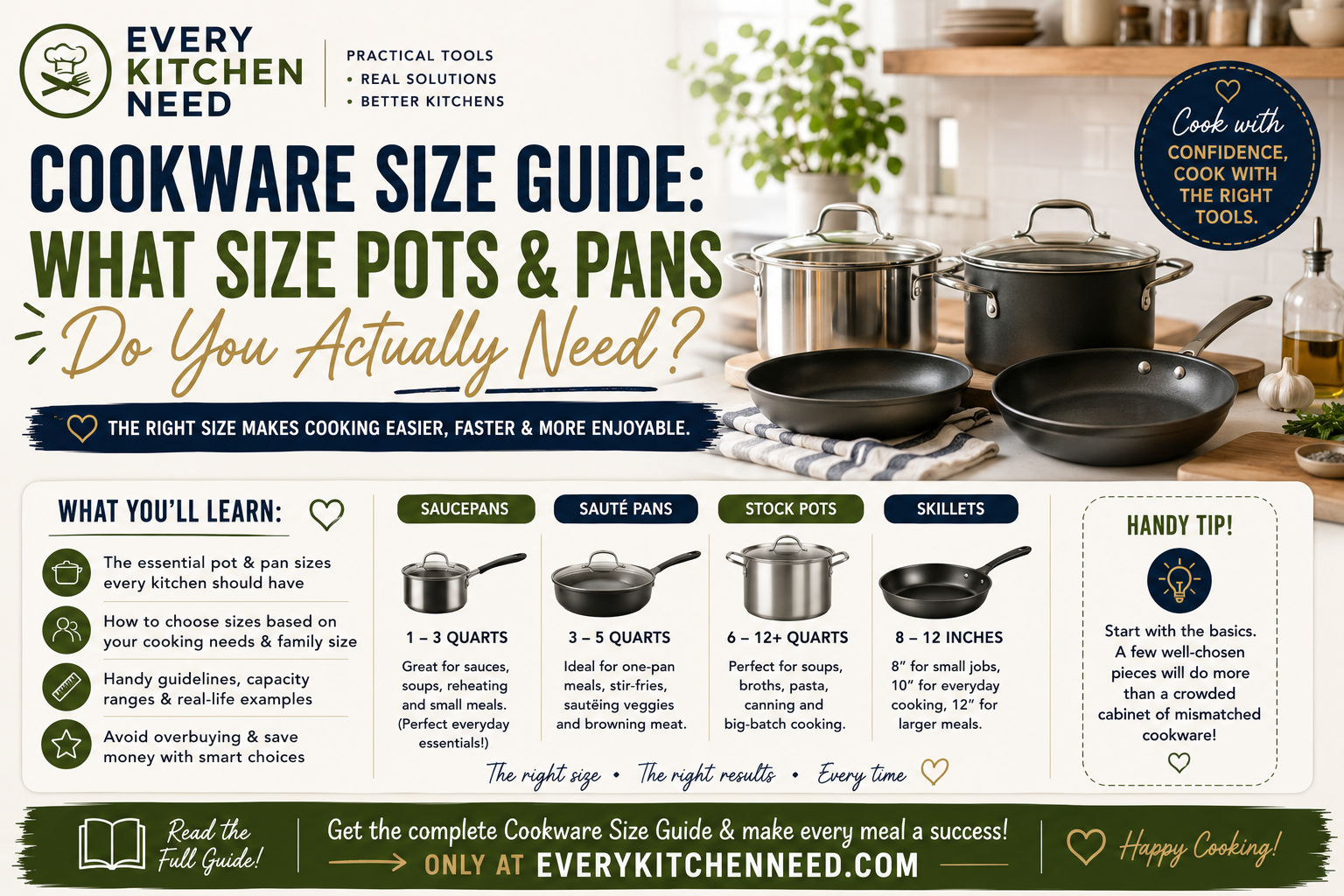
Walk into almost any cookware department and you'll find dozens of choices: 8-inch skillets, 12-inch frying pans, 1-quart saucepans, 8-quart stockpots, sauté pans, Dutch ovens, and enormous cookware sets promising everything you could possibly need.
But how many pots and pans does the average home cook actually need?
Usually, far fewer than you might think.
Choosing cookware based on the meals you prepare, the number of people you normally cook for, and the size of your kitchen can help you avoid buying pieces that spend most of their lives buried in a cabinet.
This cookware size guide will help you understand the most useful pot and pan sizes and decide which ones deserve a place in your kitchen.
Why Cookware Size Matters
The size of your cookware can make a noticeable difference in how easily a meal comes together.
Use a pan that's too small and ingredients become crowded, making it harder to brown or cook evenly. Choose a pot that's unnecessarily large and you may end up using more storage space, water, and energy than the meal requires.
The goal isn't to own every available size.
It's to have a practical selection of cookware that matches the way you actually cook.
What Size Skillet Do You Need?
A good skillet is one of the most frequently used pieces of cookware in many kitchens.
8-Inch Skillet
An 8-inch skillet is useful for smaller cooking jobs, including:
- One or two eggs
- Small portions of vegetables
- Toasting nuts or spices
- Single servings
- Small side dishes
It's particularly convenient for one-person households or when you don't want to pull out a larger pan.
10-Inch Skillet
For many home cooks, a 10-inch skillet is an excellent everyday size.
There's enough room for many common meals without the pan becoming overly large or cumbersome.
Use it for eggs, vegetables, chicken, burgers, grilled sandwiches, smaller stir-fries, and everyday stovetop cooking.
12-Inch Skillet
Cooking for several people?
A 12-inch skillet gives ingredients more room and is particularly useful for:
- Family meals
- Larger portions of meat
- Stir-fries
- One-pan dinners
- Sautéed vegetables
- Batch cooking
If you regularly cook for a family, a 12-inch skillet may become one of your most-used pans.
What Size Saucepan Do You Need?
Saucepans are the smaller, deeper pots typically equipped with one long handle.
They're incredibly versatile.
1-Quart Saucepan
A small 1-quart saucepan works well for tasks such as warming sauces, melting butter, heating small portions, or preparing individual servings.
It's useful, but many households can get by without one.
2-Quart Saucepan
A 2-quart saucepan is one of the most practical sizes for everyday kitchens.
It's suitable for:
- Rice and grains
- Sauces
- Oatmeal
- Small portions of pasta
- Vegetables
- Reheating soup
- Smaller meals
For one- or two-person households, this size can handle a surprising number of jobs.
3-Quart Saucepan
A 3-quart saucepan offers extra capacity without becoming particularly bulky.
It's a good choice for larger portions of vegetables, grains, sauces, soups, and side dishes.
For many kitchens, having one 2-quart and one 3-quart saucepan provides plenty of flexibility.
What Size Sauté Pan Is Best?
Sauté pans resemble skillets but usually have straight sides and often come with lids.
Those higher sides make them particularly useful for dishes involving sauces or larger quantities of ingredients.
A 3- to 5-quart sauté pan works well for most households.
You can use one for:
- One-pan meals
- Browning meat
- Sautéing vegetables
- Shallow frying
- Pasta dishes
- Chicken and sauce recipes
- Larger portions of food
If you're trying to keep your cookware collection small, a quality sauté pan can be one of the most versatile pieces you own.
What Size Stockpot Do You Need?
Stockpots are tall, deep pots designed for larger-volume cooking.
6-Quart Stockpot
A 6-quart pot is a practical choice for many everyday households.
It's large enough for soups, chili, pasta, potatoes, and other family meals without taking up excessive cabinet space.
8-Quart Stockpot
If you regularly cook larger quantities, an 8-quart stockpot provides additional flexibility.
It's useful for:
- Large batches of soup
- Pasta
- Homemade stock
- Chili
- Corn on the cob
- Meal prepping
- Cooking for guests
12-Quart and Larger Stockpots
Large stockpots make sense when you regularly prepare food in significant quantities.
They can be useful for big-batch cooking and certain food-preservation tasks, but they're probably unnecessary for someone who normally prepares dinner for one or two people.
Don't buy the largest stockpot simply because it seems more versatile. Consider how you'll actually use and store it.
What Cookware Sizes Does the Average Kitchen Really Need?
You don't necessarily need a 10- or 15-piece cookware set to create a functional kitchen.
For many home cooks, a practical starter collection could be as simple as:
- 10-inch skillet for everyday cooking
- 12-inch skillet for larger meals
- 2-quart saucepan for smaller cooking jobs
- 3-quart saucepan for larger sides and sauces
- 3- to 5-quart sauté pan for one-pan meals
- 6- to 8-quart stockpot for pasta, soup, chili, and larger recipes
You can then add specialty cookware as your cooking habits require it.
Choose Cookware Based on Household Size
Household size matters, but there's no perfect formula.
If you're cooking primarily for one or two people, smaller skillets, 2-quart saucepans, and a modest stockpot may cover most meals.
For a family of three or four, larger skillets and 3- to 5-quart pans become more useful because they provide enough room to prepare multiple servings at once.
Larger families or people who frequently entertain may benefit from 12-inch skillets, larger sauté pans, and 8-quart or larger stockpots.
Think about your normal cooking routine, not the largest meal you might prepare once or twice a year.
Don't Forget About Storage
There's another measurement that matters almost as much as cookware capacity:
Your cabinet space.
Before buying a large cookware set, consider where everything will go.
Stackable cookware, removable handles, nesting designs, pan organizers, and hanging storage can help maximize smaller kitchens.
A carefully selected collection of six useful pans is often easier to organize than a 15-piece set containing several pieces you rarely touch.
Should You Buy a Cookware Set or Individual Pieces?
Cookware sets can offer good value when you'll genuinely use most of the included pieces.
However, don't assume a larger set automatically means a better deal.
Look carefully at what's included. Manufacturers may count lids as individual pieces, so a "10-piece cookware set" doesn't necessarily contain ten pots and pans.
Buying cookware individually allows you to build a collection around your cooking habits instead of somebody else's idea of the perfect kitchen.
For a new kitchen, starting with a few versatile pieces and expanding later can be a smart approach.
The Bottom Line: Buy for the Way You Cook
The best cookware collection isn't necessarily the biggest or most expensive one.
It's the one that makes preparing your normal meals easier.
Start with the basics. Pay attention to which pieces you reach for most often. Then add cookware when you discover a genuine need for it.
You'll save cabinet space, avoid unnecessary purchases, and build a kitchen around tools you'll actually use.
At Every Kitchen Need, our goal is to help you find practical kitchen tools and solutions that make everyday cooking easier.
The right size. The right tool. A better kitchen.
