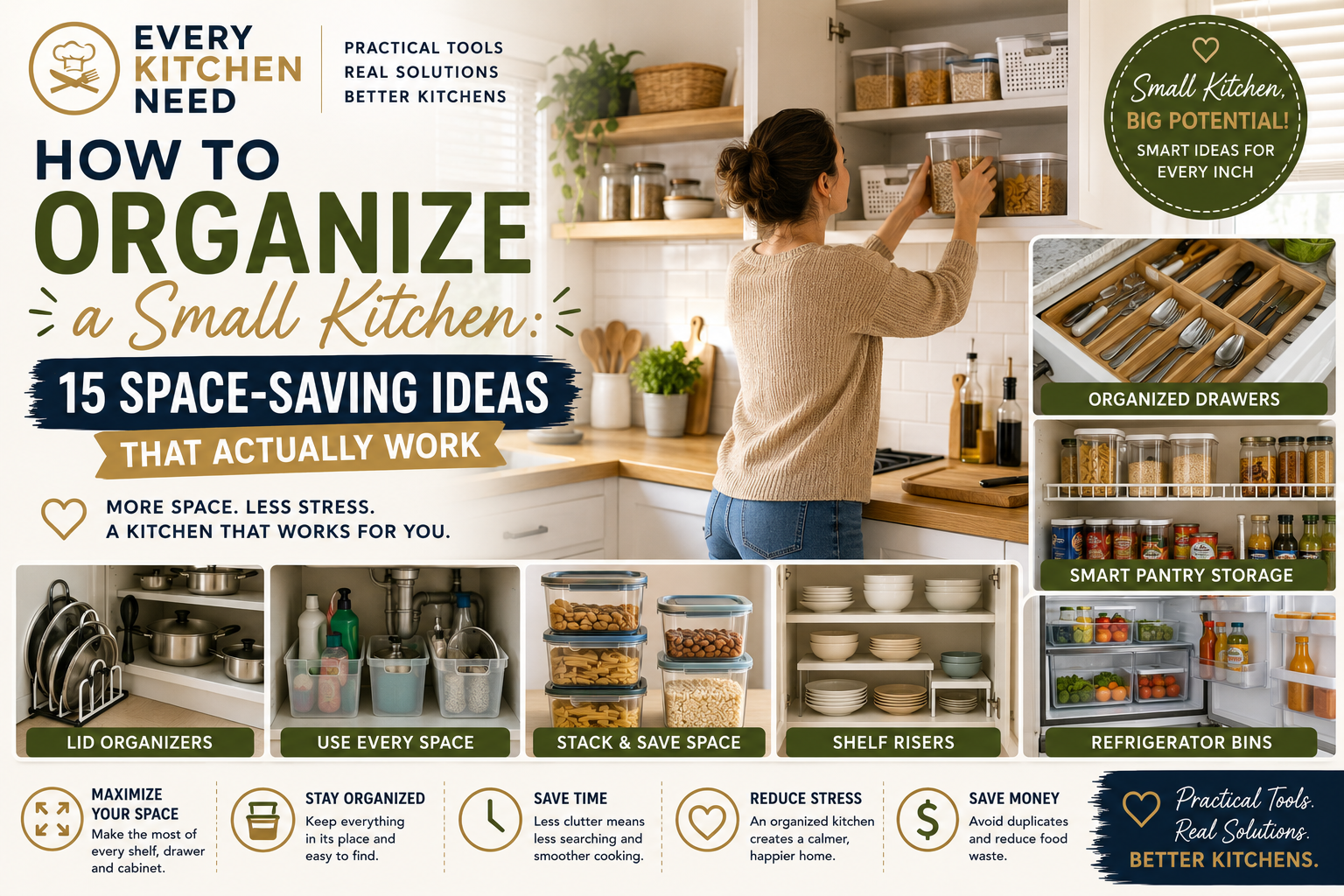
A small kitchen can be frustrating when every cabinet is full, countertops disappear under appliances, and finding one cooking tool means moving five others out of the way.
But a smaller kitchen doesn't necessarily need more storage.
Often, it needs better use of the storage you already have.
Whether you're working with an apartment kitchen, condo, compact home, or simply a kitchen with limited cabinets, a few practical changes can make the space easier to cook in and easier to keep organized.
Here are 15 practical space-saving kitchen ideas you can put to work.
1. Start by Removing What You Don't Use
Before buying organizers, create some space.
Go through your cabinets and drawers and look for things you rarely or never use. That might include duplicate utensils, mismatched food containers, specialty gadgets you haven't touched in years, chipped dishes, or cookware that doesn't suit the way you cook.
Ask yourself:
Have I used this within the past year?
If not, consider whether it deserves valuable kitchen space.
Organizing unnecessary items simply gives you better-organized clutter.
If you're setting up a kitchen from scratch, our Ultimate First Apartment Kitchen Checklist can also help you distinguish between useful essentials and items that can wait.
2. Keep Your Countertops as Clear as Possible
Counter space is especially valuable in a small kitchen.
It's tempting to keep appliances, utensil holders, knife blocks, decorations, and food containers on the counter because they're convenient. But too many items can leave you without enough room to actually prepare food.
Reserve countertop space for the things you use frequently.
An appliance you use twice a year probably doesn't need permanent countertop real estate.
If you're looking for appliances that genuinely earn their space, browse our Small Kitchen Appliances collection before deciding what belongs on your counter.
3. Use Vertical Cabinet Space
Open a kitchen cabinet and look above your plates, mugs, or food containers.
See empty space?
That's potential storage.
Shelf risers can create another usable level inside tall cabinets, allowing you to stack items without creating unstable towers.
They can work particularly well for plates and bowls, mugs, canned foods, pantry staples, and small containers.
Sometimes the easiest way to gain kitchen storage is to look upward.
You can explore additional Kitchen Storage & Organization solutions when you're trying to make better use of cabinets, counters, and pantry space.
4. Add Storage to Cabinet Doors
The inside of a cabinet door is often completely unused.
Depending on the cabinet and available clearance, door-mounted organizers can provide convenient storage for smaller items such as measuring spoons, pot lids, cleaning supplies, food wraps, or lightweight utensils.
Just make sure anything you attach doesn't interfere with shelves or prevent the door from closing properly.
Small unused surfaces can become surprisingly valuable in a compact kitchen.
5. Organize Pots and Pans by How Often You Use Them
Cookware can consume a huge amount of cabinet space.
Instead of stacking everything randomly, keep frequently used pans within easy reach and move specialty cookware to less convenient locations.
Pan racks and dividers can also make it easier to retrieve one skillet without lifting an entire stack.
More importantly, consider whether you actually need every piece of cookware you own.
Our Cookware Size Guide: What Size Pots & Pans Do You Actually Need? explains how choosing a few versatile sizes can help you avoid filling cabinets with cookware you rarely use.
When you're ready to add or replace pieces, browse Cookware: Pots, Pans & Sets to compare options for your kitchen.
6. Store Pot Lids Separately
Pot lids are notorious cabinet troublemakers.
They slide around, fall over, and make neatly stacking cookware difficult.
A lid organizer can keep them upright and separated. Depending on your kitchen, you may also be able to store lids on the inside of a cabinet door or in a deep drawer.
The important part is giving lids their own designated place.
7. Use Drawer Dividers
Kitchen drawers become messy quickly when every utensil shares one large space.
Dividers create defined areas for different categories, such as everyday utensils, measuring tools, serving utensils, baking tools, and small gadgets.
You don't necessarily need a complicated organizer. Even simple adjustable dividers can make a drawer much easier to use.
For frequently used prep tools, our Kitchen Tools & Gadgets section can help you find practical additions without filling your drawers with unnecessary gadgets.
8. Choose Stackable Food Storage
Food-storage containers can create an impressive amount of chaos.
Whenever possible, choose containers designed to nest or stack.
Try keeping containers and their matching lids together by size or type.
And don't be afraid to get rid of containers that have permanently lost their partners.
A container without a lid isn't helping your storage problem.
If food and pantry storage is one of your biggest challenges, use our Pantry Organization Checklist to work through the space systematically rather than simply buying more containers.
9. Make Better Use of the Space Under Your Sink
The cabinet beneath the sink can be difficult because pipes and plumbing occupy much of the available space.
Rather than treating it like one large empty box, use smaller bins or organizers that fit around the plumbing.
This area can work well for dishwashing supplies, sponges, cleaning cloths, trash bags, dishwasher supplies, and frequently used cleaning products.
Avoid storing anything that could be damaged if the plumbing leaks.
You can also browse Kitchen Cleaning & Maintenance Supplies when organizing your everyday cleaning essentials.
10. Use Clear Pantry Containers Strategically
You don't need to transfer every ingredient into matching containers to have an organized pantry.
However, clear containers can be useful for frequently used dry goods because you can quickly see what you have.
Consider them for rice, pasta, flour, sugar, cereal, oats, and frequently used baking ingredients.
The goal is function, not creating a pantry that looks perfect for a photograph.
Your pantry should make it easier to find ingredients, see what needs replacing, and prevent food from being forgotten.
11. Create Kitchen Zones
Organizing by activity can make a small kitchen much easier to navigate.
Think of your kitchen as a collection of work zones.
Cooking zone: pots, pans, spatulas, cooking oils and frequently used seasonings.
Prep zone: knives, cutting boards, mixing bowls and measuring tools.
Coffee zone: coffee maker, mugs, filters and supplies.
Baking zone: baking pans, measuring tools, flour and baking ingredients.
Keeping related items together reduces the amount of moving around you have to do while preparing food.
For baking supplies that belong together in one dedicated area, explore Bakeware & Baking Supplies.
And if cups, tablespoons, ounces and metric measurements regularly slow you down, keep our Kitchen Measurement & Conversion Chart handy in your prep or baking zone.
12. Use Wall Space When Appropriate
When cabinet space is limited, walls may offer additional possibilities.
Depending on your kitchen and rental restrictions, you might use hooks, rails, magnetic storage, hanging baskets, or small shelves.
Just be careful not to turn every available wall into storage.
Too much exposed storage can make a compact kitchen feel even more crowded.
The objective is to create useful storage without creating visual clutter.
13. Choose Multi-Purpose Kitchen Tools
Small kitchens reward versatility.
Before buying a specialized gadget, ask whether something you already own can perform the same job.
A quality chef's knife, for example, can handle many jobs that otherwise require individual cutting gadgets.
If you're unsure which knives are genuinely useful, our Kitchen Knife Guide for Beginners explains the core knives most home cooks should consider before investing in a large knife set.
Mixing bowls can sometimes double as serving bowls. A sauté pan can handle several cooking techniques. Tongs can be useful for cooking, serving, and tossing ingredients.
The fewer single-purpose tools you own, the easier your kitchen becomes to organize.
14. Don't Ignore the Refrigerator
Your refrigerator isn't just for food storage.
The side of a refrigerator may provide space for magnetic organizers, depending on its design and location.
Inside, bins can help group similar foods and prevent smaller items from disappearing behind larger ones.
But don't over-organize.
You still need adequate airflow and enough visibility to know what food you have before it goes to waste.
A system that helps you see and use your food is more valuable than one designed only to look organized.
15. Give Everything a Home
This may be the most important small-kitchen organization rule.
Every frequently used item should have a logical place to return to.
When you don't know where something belongs, it tends to end up on the countertop.
And once one thing lands there, clutter quickly attracts more clutter.
Create a simple rule:
Use it. Clean it. Put it back where it belongs.
Good organization should make that process easy.
What Should You Buy for a Small Kitchen?
Before buying an organizer, storage container, or kitchen gadget, identify the specific problem you're trying to solve.
Instead of thinking:
"I need more kitchen organizers."
Think:
"My pot lids keep falling over, so I need a better way to store my lids."
That's a much better purchasing decision.
Useful small-kitchen solutions may include cabinet shelf risers, drawer dividers, pot and lid organizers, stackable containers, under-sink organizers, hanging storage, and appropriately sized cookware.
You can start with our Kitchen Storage & Organization collection and look specifically for products that solve a problem you've already identified.
Buy solutions to real problems—not organizers simply because they look useful.
A Small Kitchen Can Still Be a Great Kitchen
You don't need an enormous kitchen to cook comfortably.
A thoughtfully organized smaller kitchen can actually be extremely efficient because everything you use regularly is within reach.
Start by removing what you don't need.
Then improve one frustrating area at a time.
Your goal isn't a picture-perfect kitchen.
It's a kitchen that's easier to cook in, easier to clean, and easier to enjoy.
At Every Kitchen Need, we're focused on practical tools and everyday solutions that help you make more of the kitchen you already have.
Practical tools. Real solutions. Better kitchens.
