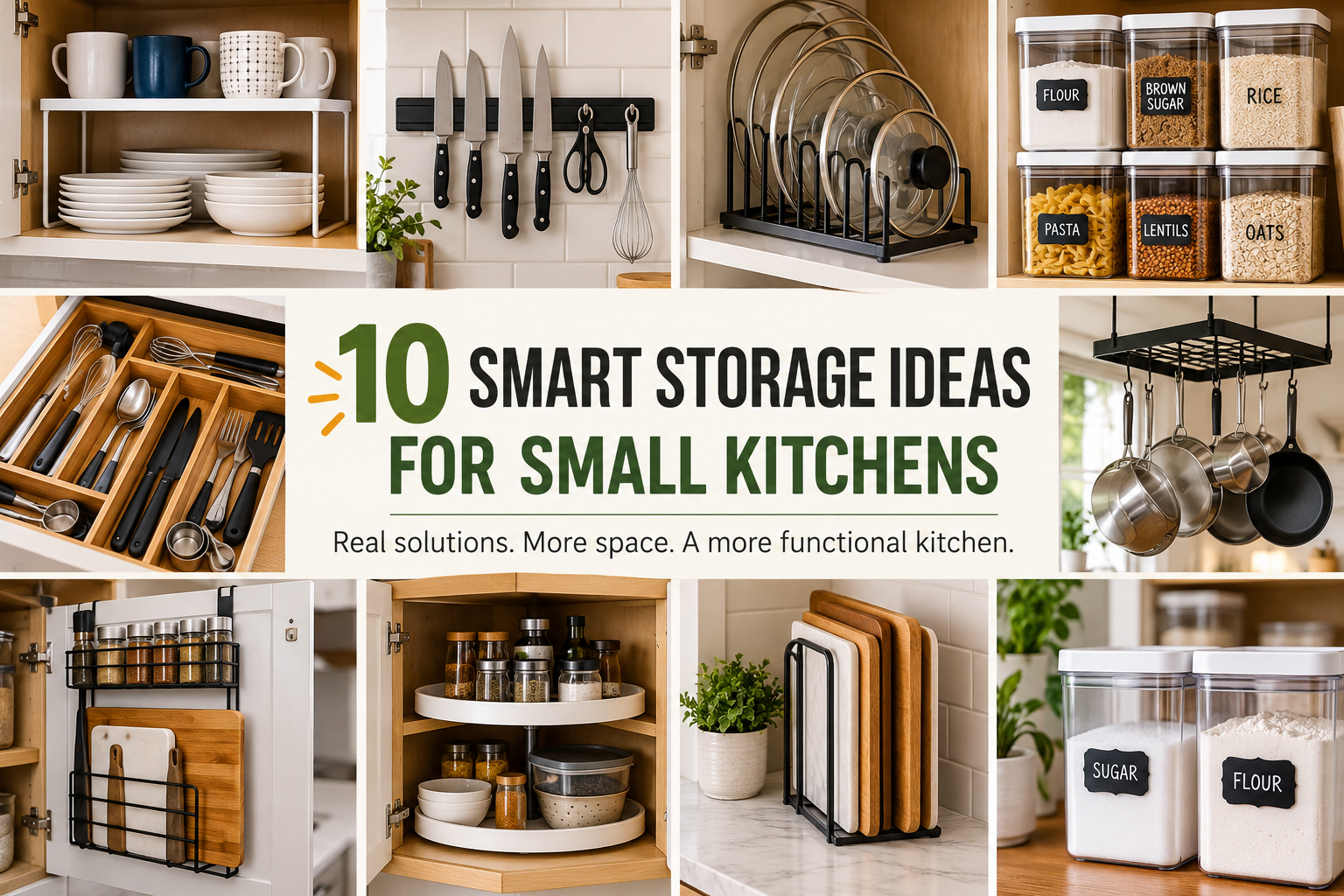
If you've ever stood in front of an open cabinet wondering how three mixing bowls turned into an avalanche, you already know the problem with most kitchen storage advice: it assumes you have space to spare. Most of us don't.
The good news is that a small kitchen doesn't need less stuff — it needs stuff to work harder. These ten ideas are built around that idea: real storage upgrades that reclaim space you're already paying rent or a mortgage on, not aspirational Pinterest boards that assume a walk-in pantry.
1. Go Vertical Inside Your Cabinets
Most cabinets waste the top third of their height, because plates and bowls stack in one column and everything above that column is dead air. A stackable shelf insert turns that dead air into a second shelf, so you can store mugs above plates instead of shoving mugs into whatever gap is left.
2. Use Wall Space You're Already Looking At
The wall between your counter and your upper cabinets is prime real estate that almost nobody uses. A magnetic knife strip or a small wall-mounted rack gets your most-used tools off the counter and off a cluttered drawer, and it looks intentional instead of makeshift.
3. Corral Your Lids Before They Corral You
Every kitchen has a drawer or cabinet that's 80% pot lids sliding around loose. A dedicated lid organizer — vertical slots that hold each lid upright — turns that mess into something you can actually find things in without unstacking six pans first.
4. Let Your Pantry Stack Sideways, Not Just Up
Bags of flour, rice, and pasta don't stack well on their own, which is why bulk goods tend to take over way more shelf space than the food inside them needs. Transferring dry goods into uniform, stackable containers — the kind that stack sideways as well as up — routinely gives people back a third of their pantry shelf without buying a single new shelf.
5. Put Your Drawers to Work With Dividers
An unorganized utensil drawer isn't just annoying, it's inefficient: you dig past six things to find the one you need, every single time. A simple drawer organizer insert fixes this permanently, and it's one of the cheapest, fastest wins on this list.
6. Hang What You Can, Store What You Can't
Pots and pans are some of the bulkiest items in any kitchen, and they rarely stack cleanly. If you have even a small stretch of open wall or ceiling space, a hanging pot rack moves your bulkiest cookware out of a cabinet entirely — freeing that cabinet for something that actually needs to be hidden.
7. Make the Back of Your Cabinet Doors Useful
The inside of a cabinet door is completely empty space in most kitchens. An over-the-door or over-the-cabinet organizer can hold spice jars, cutting boards, or cleaning supplies — storage that costs you zero counter or shelf space because it was never being used in the first place.
8. Get a Lazy Susan Into Your Corner Cabinet
Corner cabinets are famous for swallowing items whole — you know something's in there, you just can't reach it without unloading half the cabinet. A turntable/lazy susan insert solves this specific, universal frustration in about thirty seconds of setup.
9. Store Your Cutting Boards on Their Edge
Cutting boards laid flat take up as much space as a whole shelf. Stored vertically in a simple slotted rack or riser, the same three boards take up the footprint of one — and you're not lifting two boards off the top just to grab the one on the bottom.
10. Label Everything You Decant
This one's free: once you've moved dry goods into matching containers, label them. It sounds small, but an unlabeled matching container set often creates more confusion than the mismatched bags did — you can't tell flour from sugar at a glance anymore. A cheap label maker or a set of chalkboard labels closes that gap in minutes.
The Real Principle Behind All of This
Every idea above does the same two things: it uses space you already have but aren't using (vertical space, door backs, wall space), and it groups similar items together so you stop hunting. You don't need a bigger kitchen. You need the one you have to stop wasting space on air.
Ready to tackle your own kitchen? Browse our full Kitchen Storage & Organization collection for the tools mentioned above, or use the search bar to find exactly what fits your space.
Frequently Asked Questions
What's the cheapest way to organize a small kitchen?
Drawer dividers and a set of stackable pantry containers give the biggest visible improvement for the lowest cost — both are inexpensive and don't require any wall mounting or installation.
Do wall-mounted racks damage kitchen walls?
Most modern wall racks use either a light screw mount (a few small holes, easily patched) or adhesive-strip mounting for lighter loads, which leaves no damage at all. Check the weight rating before deciding which mounting style fits what you're hanging.
How do I organize a kitchen with almost no cabinet space?
Prioritize vertical and door-back storage first — stackable shelf inserts, over-the-door organizers, and a hanging pot rack all add storage without needing a single extra inch of floor or cabinet space.
