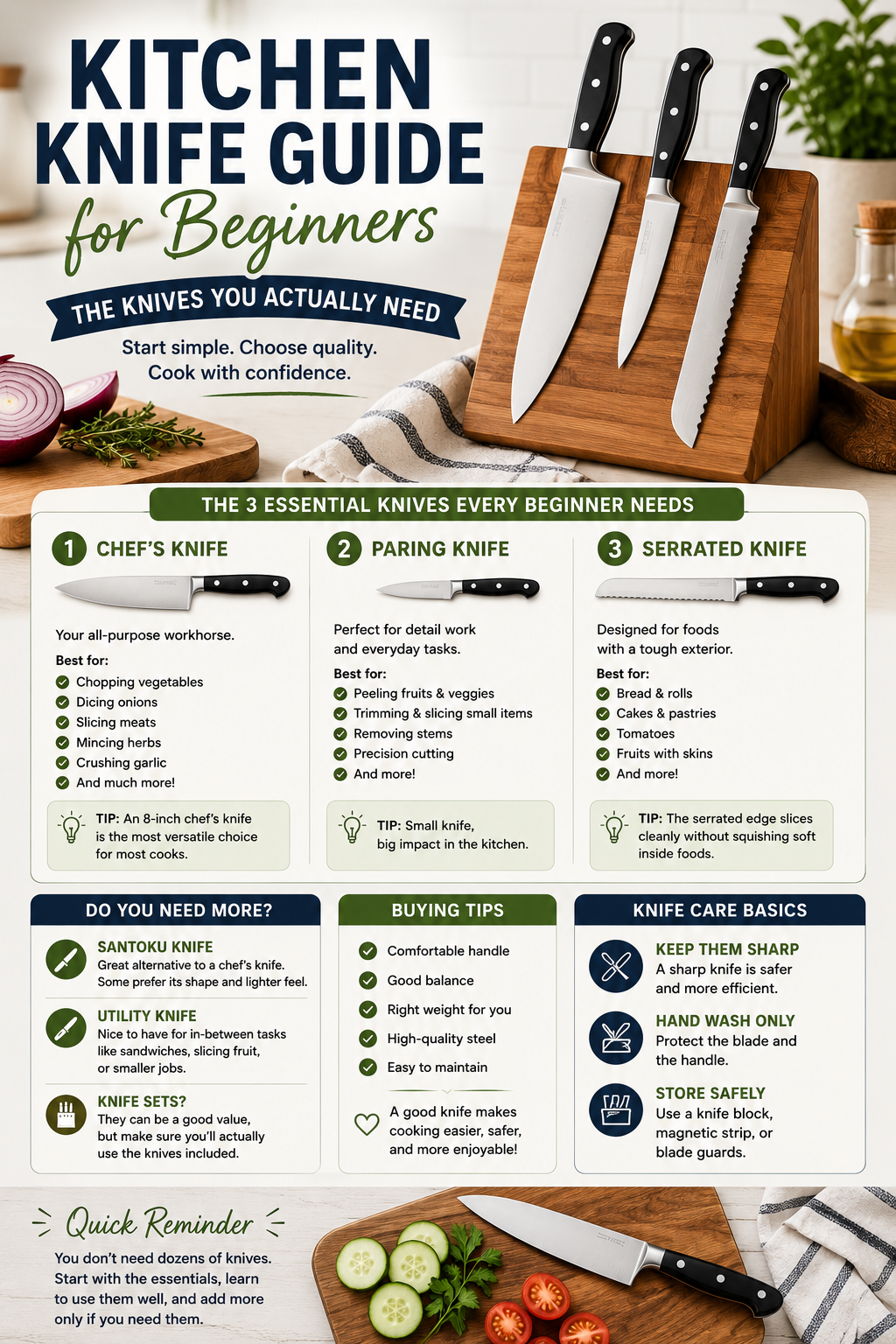
You Probably Don't Need 20 Knives
Walk past a giant knife block and you'd think preparing dinner requires a small collection of medieval weaponry.
It doesn't.
Most home cooks can accomplish the overwhelming majority of everyday food preparation with three essential kitchen knives.
If you're putting together an entire kitchen—not just your knife collection—start with our Ultimate First Apartment Kitchen Checklist for a practical breakdown of cookware, utensils, appliances, storage, and other everyday essentials.
1. Chef's Knife
If you're buying one serious kitchen knife, start here.
A chef's knife handles:
- Chopping vegetables
- Dicing onions
- Mincing herbs
- Slicing many meats
- Crushing garlic
- General food preparation
An 8-inch chef's knife is a common all-purpose choice, although comfort and control matter more than following a particular size recommendation.
2. Paring Knife
A chef's knife can feel oversized for detailed work.
That's where the paring knife comes in.
Use it for:
- Peeling
- Trimming
- Small fruits and vegetables
- Removing stems
- Detailed preparation
Its smaller blade gives you more control for delicate tasks.
3. Serrated Bread Knife
Those teeth aren't only useful for bread.
A serrated knife works well for foods with a tougher exterior and softer interior.
Think:
- Crusty bread
- Rolls
- Cakes
- Tomatoes
- Certain fruits
What About a Santoku?
A santoku can be an excellent alternative or complement to a chef's knife.
Some people prefer its shape, balance, lighter feel, or chopping motion.
There isn't a universal winner between the two.
Choose whichever feels more comfortable and matches the way you prepare food.
Do You Need a Utility Knife?
Maybe.
A utility knife fills the gap between a chef's knife and paring knife.
It's convenient for sandwiches, smaller produce and miscellaneous cutting tasks.
But it's not necessarily essential when you're starting out.
Should Beginners Buy a Knife Set?
Knife sets can offer good value—but only when you'll actually use the knives.
Before buying a 15-piece block, look at what's included.
Are you getting useful kitchen knives?
Or are you paying for six blades you don't understand and eight steak knives?
For many beginners, investing in three good knives individually is the smarter starting point.
What Should You Look for in a Kitchen Knife?
Comfortable Handle
Your knife should feel secure and comfortable.
Good Balance
You shouldn't feel like you're fighting the knife while using it.
Appropriate Weight
Some cooks prefer heavier knives; others prefer lightweight designs.
Neither preference is automatically better.
Maintainable Edge
Every knife eventually requires maintenance.
Consider how the manufacturer recommends sharpening and caring for the blade.
The right knife is only one part of an efficient food-prep setup. Browse our Kitchen Tools & Gadgets for more practical tools that can make everyday preparation easier.
Don't Forget the Cutting Board
Your knife and cutting board work as a team.
Choose an appropriate cutting surface and avoid surfaces that are unnecessarily hard on knife edges.
Once your food-prep setup is covered, choosing the right cookware is another important step. Our Cookware Size Guide explains which pot and pan sizes are actually useful for everyday home cooking.
Store Knives Properly
Avoid throwing good knives loose into a crowded utensil drawer.
Consider:
- Knife block
- Magnetic knife holder
- In-drawer knife organizer
- Individual blade guards
Proper storage protects both the blades and your fingers.
Sharp Knives Matter
Even a quality knife won't remain sharp forever.
Honing and sharpening aren't necessarily the same thing. Honing helps maintain alignment of an edge, while sharpening removes material to restore an edge.
Follow the care instructions appropriate for your particular knife.
Final Thoughts
Start simple:
Chef's knife + paring knife + serrated knife.
Learn to use those confidently.
Then add additional knives because you've discovered a real need—not because an enormous knife block had an empty slot.
